Before the hands ever touch the body, the breath has already begun the work.
Most people walk into a healing session the same way they walk into everything else — mid-thought, mid-rush, still half in the last thing they were doing.
It's understandable. Life doesn't usually give you a quiet runway before the things that matter. You finish a call, close the laptop, and lie down on the table still carrying the conversation in your shoulders. But Reiki, Cosmic Healing, and most genuine energy work all depend on something that can't happen while you're still mentally somewhere else: your willingness to actually receive.
This is where breathwork earns its place — not as a nice-to-have warm-up, but as the actual doorway into the session. A few minutes of conscious breath before the work begins changes the entire shape of what follows.
Breath as the
Bridge
In the yogic model, the breath isn't just a biological function — it's described as the bridge between the physical body and the energetic body, the pranamaya kosha. We can go weeks without food and days without water, but only minutes without breath. That alone says something about how central it is to the entire system.
Every other process in the body runs largely on autopilot. Breath is the one function that lives in both worlds — it happens automatically, but it's also the one thing you can reach in and consciously change at will. That dual nature is exactly what makes it so useful right before a healing session: it's the one lever you have direct access to that also reaches all the way down into the energy body.
Change the breath deliberately, even briefly, and you're not just calming your mind. You're adjusting the channel the healing energy will move through.
Why the Nervous System
Has to Go First
Most of us arrive at a session in some degree of sympathetic activation — the body's alert, "keep moving" state. It doesn't have to feel dramatic. Even ordinary daily stress, low-grade and constant, keeps the nervous system mildly braced without you noticing.
A body in that state is, quite literally, organized around vigilance rather than receiving. Muscles stay slightly guarded. Breath stays shallow and high in the chest. Attention stays scattered across whatever's still unresolved from the day. None of this is wrong or a personal failing — it's simply what a nervous system primed for alertness looks like.
Slow, conscious breathing — particularly breathing out longer than you breathe in — is one of the most direct ways to shift the nervous system out of that alert state and into its parasympathetic, "rest and digest" mode. This isn't a metaphor; it's measurable. Slower exhales stimulate the vagus nerve, which signals the body that it's safe to soften.
What a Few Minutes of Breath Actually Does
Slows the heart rate. Longer exhales activate the vagus nerve and ease the body out of alertness.
Lowers muscular guarding. Tension held in the shoulders, jaw, and abdomen begins to release before the practitioner even touches you.
Brings attention into the present. The mind has somewhere to land other than tomorrow's to-do list.
None of the deeper energetic work that follows in a session can move efficiently through a nervous system that's still bracing. Breath is what gets the body out of the way first.
A Closed Body
Can't Receive
Beyond the nervous system, there's a more subtle reason breath matters so much going in. Healing modalities like Reiki and Cosmic Healing work by inviting universal energy to move through and around the recipient. But energy follows openness. A body that's tight, a mind that's racing, and a breath that's shallow all create a kind of contraction — and contraction is the opposite of the receptive state these sessions are built to use.
You don't have to believe anything in particular for this to be true. Even setting energy work aside entirely, anyone who has tried to fall asleep, meditate, or simply relax while their mind was still spinning from the day knows this in their own body: you can lie perfectly still and still be completely unavailable.
A practitioner can offer everything they have. What the breath does is make sure there's actually a door open to receive it.
This is part of why even a short, structured practice like Anulom Viloma — done for around ten minutes before a session — tends to deepen what follows noticeably. It isn't about achieving a perfect, thought-free state before you begin. It's about softening the grip enough that the body stops working against what's coming.
Anulom Viloma:
A Practice to Use Beforehand
If you only learn one pranayama technique to use before sessions, make it Anulom Viloma — alternate nostril breathing. It's one of the oldest tools in the yogic tradition specifically for balancing the energy body, and it's simple enough to do confidently after a single read-through.
- Find stillness first. Sit comfortably with your spine reasonably upright, ideally in the same space where the session will happen. Let your shoulders drop.
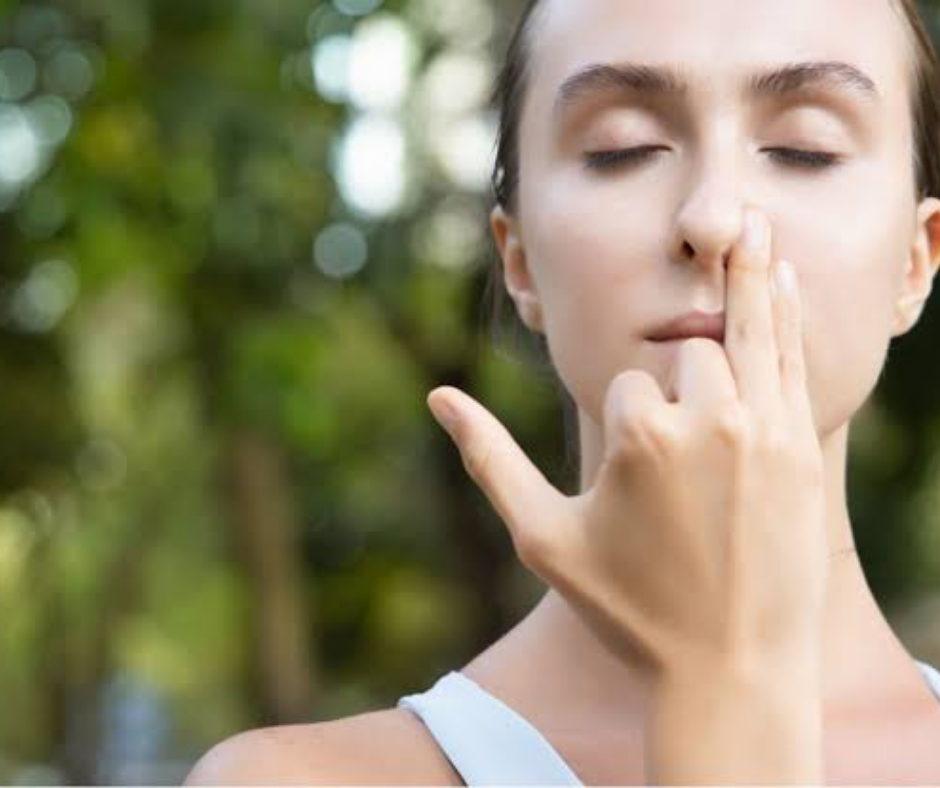
- Set your hand. Bring your right hand up, folding the index and middle fingers into the palm. You'll use the thumb to close the right nostril and the ring finger to close the left.
- Begin the cycle. Close the right nostril with your thumb and inhale slowly through the left. Close the left nostril with your ring finger, release the thumb, and exhale through the right. Inhale through the right, then switch again — close the right, exhale through the left. That's one full round.
- Keep it slow and even. There's no need to force the breath or stretch the count. A natural, unhurried four-count in and four-count out is enough — smoothness matters more than length.
- Continue for 10 minutes. Let the rounds repeat at their own pace. If you lose count of which side you're on, simply start again from the left — there's no penalty for losing the thread.
- Close gently. Lower your hand, let the breath return to normal, and sit for a moment before the session begins.
If thoughts intrude — and they usually will — there's no need to fight them. Simply notice, and return attention to the next switch of the breath. The goal isn't a blank mind; it's a body and an energy system that have come back into balance before the work begins.
Why Alternate Nostril Breathing Specifically
Yogic tradition holds that the left nostril channel (ida) and right nostril channel (pingala) carry distinct qualities of energy — calming and activating, respectively. Anulom Viloma deliberately moves breath through both in turn, which is said to balance the two and settle the subtler channel between them. Whether you read that energetically or simply as a structured way to slow and even out the breath, the practical effect is the same: a calmer, more centered state heading into the session.
What Changes When
You Arrive Open
Practitioners who work with clients regularly often notice the difference immediately. Someone who arrives still mid-rush takes longer to settle into the session, and the depth of what they experience can stay shallower throughout. Someone who's already spent ten minutes in Anulom Viloma tends to drop in faster, report stronger sensation, and often describe more noticeable shifts afterward — emotionally, physically, or both.
This isn't a verdict on anyone's openness or spiritual capacity. It's simply a function of physiology and energy meeting in the same place: a calmer nervous system and a more balanced energetic body give the work somewhere to land.
If You're New to This
You don't need to be skilled at pranayama, or even particularly calm by nature, for this to help. Anulom Viloma is forgiving — losing track of which nostril you're on, or sitting for a slightly imperfect ten minutes, still tends to outperform walking in cold with no transition at all.
Healing sessions, whatever form they take, ask something specific of you: a willingness to stop doing for a little while and simply receive. Breath is how the body learns to do that — quickly, reliably, and without needing anything more than ten quiet minutes of Anulom Viloma and a willingness to slow down before you begin.
Start with a Free Guided Meditation
The easiest way to feel what conscious breath actually does is to experience it directly. Start with a free guided meditation, and if you'd like ongoing support with breathwork, meditation, and reflection, The Confluence community is open and free to join.