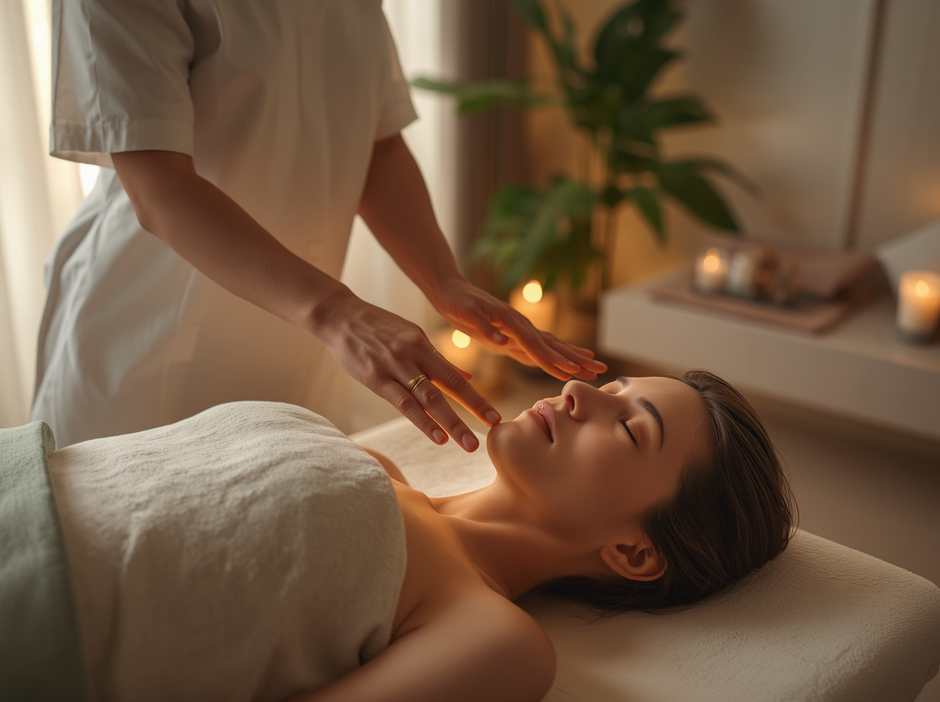
A Reiki session: hands channeling, not giving from one's own energy.
You've heard the word. Maybe a friend mentioned it, or you saw it on a wellness app, or you've felt drawn to it without quite knowing why.
Reiki is one of the most widely practiced forms of energy healing in the world — and also one of the most misunderstood. Some people picture it as a kind of spiritual massage. Others assume it's a religion, or that you need to be "spiritual" already to try it. Neither is true.
This guide is for the complete beginner: what Reiki actually is, what the levels mean, what an attunement really involves, and what to expect if you've never experienced it before.
What Is Reiki,
In Plain Terms?
Reiki is a Japanese healing practice developed in the early 20th century. The word itself combines rei (spirit, or universal) and ki (life energy) — together, "universal life force energy."
The idea behind Reiki is simple: there is a subtle energy that flows through all living things, and when that flow becomes blocked or depleted — through stress, illness, emotional strain, or simply the wear of daily life — we feel it. Tiredness, anxiety, physical discomfort, and a general sense of being "off" can all be signs of energy that isn't moving freely.
A Reiki practitioner channels this universal energy, usually through the hands, to support the body's own capacity to rebalance and heal. The practitioner isn't using their own personal energy — they're acting as a clear channel for something larger than themselves.
What Reiki Is Not
Reiki is not a religion, and it doesn't require any particular belief system to receive or learn it. It is not a substitute for medical care — it works alongside conventional treatment, never in place of it. And it is not something only "gifted" people can do. With proper attunement, anyone can learn to channel this energy.
The Levels of
Reiki Explained
Traditional Reiki training is divided into levels, each building on the one before. The Japanese terms are still widely used:
This is where everyone starts. You receive your first attunement, learn the history and principles of Reiki, the seven chakras, and the hand positions for self-treatment and treating others. No prior experience of any kind is needed — the attunement itself is what opens you to the energy, not anything you need to "achieve" first.
Level 2 introduces the three traditional Reiki symbols and a second attunement that deepens your connection to the energy. This level also opens the door to distance healing — sending Reiki to someone who isn't physically present, since energy is not bound by physical distance.
The Master level deepens your practice further and traditionally includes the ability to attune others. This is generally for those who want to teach, or who simply want to go as deep into the practice as the lineage allows.
You don't need to rush through these. Many practitioners spend months or years living with Level 1 before moving on — there's no requirement to move quickly, and the energy itself tends to ask for integration time between levels.
What an Attunement
Actually Is
This is the part beginners are most curious — and sometimes most uncertain — about. An attunement is the process through which a student becomes able to channel Reiki energy. Without it, the techniques and hand positions alone wouldn't carry the same transmission. It is the attunement that actually opens the channel.
Not all attunements are equal, though, and this matters more than most beginners realize. There's a real difference between an attunement that comes from a recorded video, an automated online course, or someone newly certified passing along something they don't yet fully understand — and an attunement transmitted by a master working within an unbroken, living lineage.
What a Genuine Attunement Involves
In an authentic transmission, the attunement is prepared personally for you — calibrated to your own energy, not delivered as a one-size-fits-all recording. It may be given in person or, in many traditions, as a distance attunement, since energy itself isn't limited by physical proximity.
Once it's prepared, you're guided to receive it in your own sacred space, in your own time. Some people feel warmth, tingling, or a wave of emotion in the moment. Others feel very little at first and notice the shift in the days that follow. Both are completely normal — the attunement has happened either way.
If you're choosing where to train, it's worth asking directly: where does this lineage come from, and who is actually preparing the attunement? A clear, honest answer is a good sign. Vagueness is worth paying attention to.
What a Reiki Session
Feels Like
Whether you're receiving Reiki from a practitioner or learning to give it yourself, a typical session is quiet and unhurried. You stay fully clothed, lying down or seated comfortably, while the practitioner places their hands lightly on or just above different points on the body — often following a sequence that moves from the head down toward the feet.
Sessions usually last somewhere between 30 and 90 minutes. Common sensations include:
- Warmth or gentle heat, especially where hands are placed
- A subtle tingling or pulsing sensation
- Deep relaxation, sometimes drifting into a light sleep
- Emotional release — unexpected tears are not unusual and are considered a healthy sign of release
- Mental clarity or a sense of lightness afterward
Some people feel a lot. Some feel very little in the moment but notice effects — better sleep, eased tension, emotional shifts — in the days that follow. Neither response means it "didn't work." Energy moves differently for everyone.
Is Reiki Safe?
Does It Work?
Reiki is considered very safe and gentle. Because it works with the body's own energy rather than introducing anything external, there's no risk of overdose or harmful side effects. It's widely used as a complementary therapy alongside conventional medicine — including, in many hospitals, alongside cancer treatment, surgery recovery, and chronic pain management.
As for whether it "works" — research into Reiki is still developing, and results vary across studies. What's consistently reported, both in research and in practitioner experience, is meaningful support for stress, anxiety, and overall wellbeing. Reiki is not a replacement for medical care, and any serious health concern should always be brought to a qualified doctor first. Reiki works alongside medical treatment, never instead of it.
Reiki doesn't ask you to believe anything in particular. It simply asks you to be open to receiving — and to notice, in your own experience, what happens next.
If You're Ready
to Begin
If something in this article resonated, that's usually a good sign — many practitioners describe being drawn to Reiki before they could fully explain why. You don't need any experience, any particular belief, or any special sensitivity to begin. The attunement itself is what opens the door.
What matters most, especially at the start, is choosing a teacher and a lineage you trust — one that's transparent about where the training actually comes from.
Start with Reiki Level 1
Reiki Level 1 (Shoden) includes a personal attunement prepared through a living lineage — not a recording, not an automated course. You'll learn the chakras, the five Reiki principles, and everything you need to begin treating yourself and others.