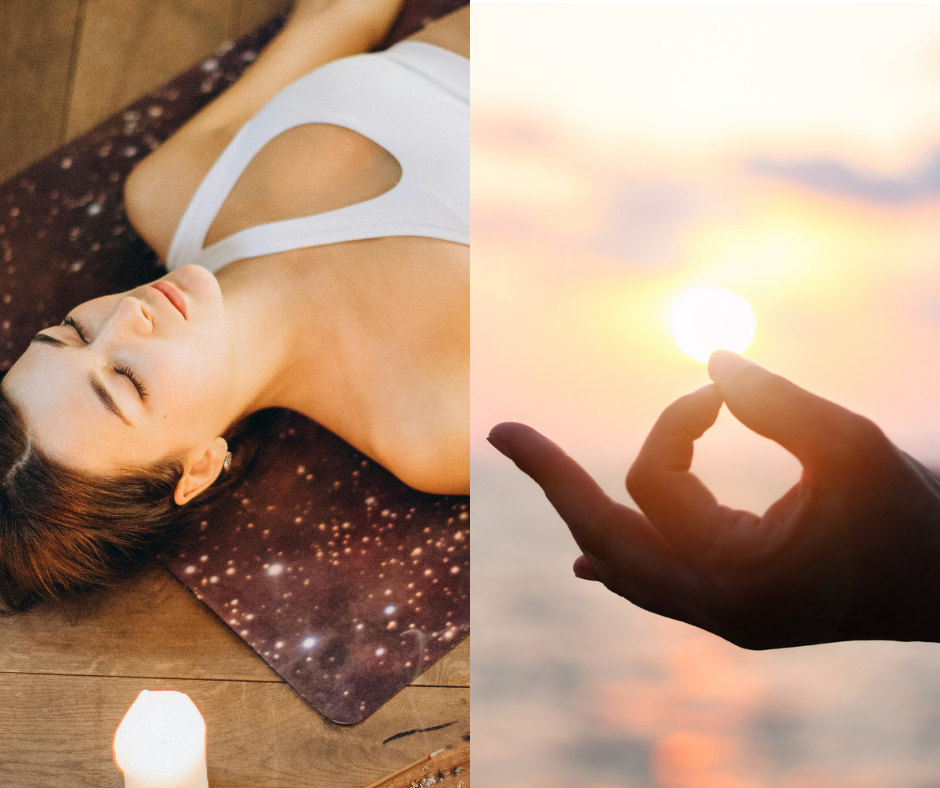
Two doors into stillness — one through surrender, one through sustained awareness.
If you've ever tried to calm a busy mind, you've probably crossed paths with both — and maybe assumed they were the same thing.
Yoga Nidra and meditation get used interchangeably online, in yoga studios, and even in wellness apps. At first glance, the confusion makes sense: both involve stillness, both invite you inward, both ask you to step away from the noise of ordinary thinking.
But they work on the nervous system in genuinely different ways — different posture, different state of consciousness, different mechanism entirely. If you're choosing between them, or wondering why one works for you and the other doesn't, understanding the real difference matters.
What Meditation
Actually Trains
Meditation is an umbrella term covering many techniques — mindfulness, mantra-based practice, breath-focused practice — but at the core of nearly all of them is the same basic instruction: stay awake, stay aware, and gently bring your attention back whenever it wanders.
This is, quite literally, a workout for attention. You notice the mind drifting toward a thought, a worry, a plan for tomorrow — and you bring it back to the breath, the mantra, or the present moment. That returning, over and over, is the practice. The effort is the point.
Meditation is almost always practiced seated, with the spine upright. This isn't incidental — staying upright keeps you anchored in alert, waking consciousness even as the mind settles.
What Yoga Nidra
Actually Does
Yoga Nidra — sometimes translated as "yogic sleep" — works almost the opposite way. Rather than training the mind to hold focus, it guides you into a state of conscious surrender. You lie down, usually in Savasana (corpse pose), and follow a structured guided practice through body awareness, breath, and visualization.
The goal isn't to maintain sharp focus — if your attention drifts, that's expected, even welcomed. You're not fighting the mind's tendency to wander; you're being guided through it. This is why people who find seated meditation frustrating often take to Yoga Nidra immediately — there's nothing to "fail" at.
Physiologically, Yoga Nidra holds you in the hypnagogic state — that liminal zone between waking and sleep most of us pass through in seconds without noticing, usually right before falling asleep. Yoga Nidra deliberately stretches that doorway out, sometimes for 20 to 45 minutes, keeping you conscious while your brain shifts into slower alpha and theta wave patterns more typical of light sleep.
The Core
Differences
Meditation is practiced seated, spine upright. Yoga Nidra is practiced lying down, fully supported.
Meditation is an active training of attention — noticing, returning, repeating. Yoga Nidra is a guided surrender; there's nothing to actively hold onto.
Meditation keeps you fully awake and alert throughout. Yoga Nidra holds you in the hypnagogic zone between waking and sleep — conscious, but on the very edge of it.
Meditation can be unstructured or self-directed. Yoga Nidra is highly structured, traditionally moving through a defined sequence of stages led by a guide's voice.
Rare in seated meditation. Common in early Yoga Nidra practice — and not considered a failure, just part of learning to stay conscious in that in-between state over time.
What the
Research Shows
Both practices are genuinely well-supported by research into stress and anxiety reduction, but they don't always produce identical results. A college-professor study comparing the two found that while both groups saw real reductions in stress over three months, Yoga Nidra showed a particular edge for anxiety specifically.
More recently, a large 2026 meta-analysis pooling 73 trials and over 5,000 participants found meaningful reductions in stress, anxiety, and depression from Yoga Nidra practice compared to active control conditions — among the most comprehensive evidence yet gathered on the practice specifically. The researchers were careful to note that protocols varied considerably across the studies, so the true effect is likely smaller than the headline numbers suggest — but the overall direction of the evidence is consistent.
A Note on Trauma & Sensitivity
Yoga Nidra is safe for most people, but if you carry unresolved trauma, severe depression, or PTSD, it's worth practicing with a trauma-informed teacher rather than diving in alone — the deep, undefended state it invites is part of its benefit, but that same openness means it's not the right starting point for everyone without support.
Which One Is
Right for You?
You don't have to choose only one — many people use both, for different purposes. As a rough guide:
- Reach for meditation if you want to build sustained focus, train present-moment awareness during the day, or you're working with a teacher toward deeper states of insight over time.
- Reach for Yoga Nidra if you struggle to sit still, want help winding down before sleep, are recovering from burnout or chronic stress, or simply find seated practice frustrating rather than calming.
Yoga Nidra can also prepare the body and mind for meditation — when the nervous system is already calm, sitting in stillness afterward tends to come much more easily.
Neither practice is "better." They're different doors into the same room — inner stillness, self-awareness, and a quieter relationship with your own mind.
Start with a Free Guided Meditation
The easiest way to feel the difference is to experience it directly. Start with a free guided meditation, or go deeper with three days of live distance healing.